


PRESS RELEASE: Public Survey Results Indicate Waning Japanese Consumption of Ivory
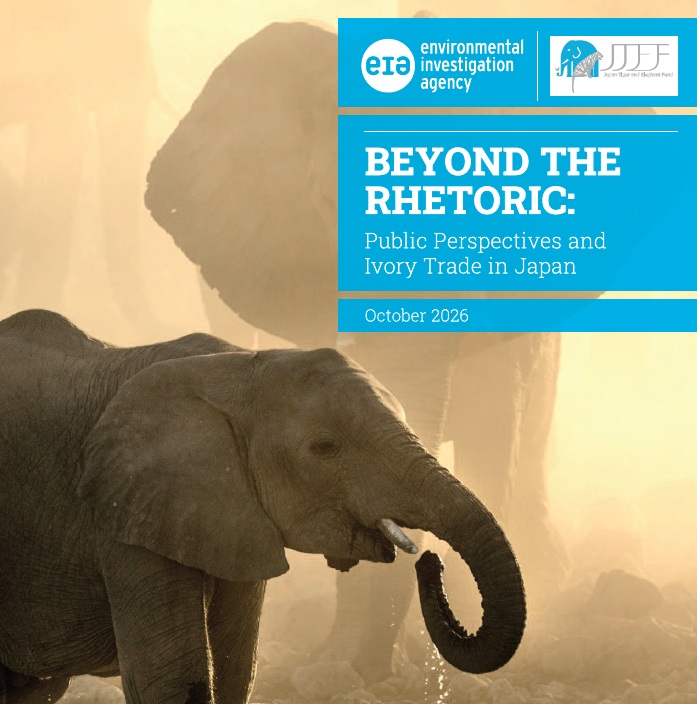
https://www.jtef.jp/en/wp-content/uploads/2026/11/report-cover_EN_square.jpg 697 704 Japan Tiger Elephant Organization Japan Tiger Elephant Organization https://www.jtef.jp/en/wp-content/uploads/2026/11/report-cover_EN_square.jpgCampaigners call on the Japanese government to close the domestic ivory market
Tokyo and Washington, DC – Japanese demand for elephant ivory is limited and in steady decline according to public survey results published today in a new report by the Environmental Investigation Agency US (EIA) and Japan Tiger and Elephant Fund (JTEF). Despite diminishing public interest in ivory, Japan maintains a legal domestic market for elephant ivory. However, Japanese policymakers are in the final stages of reviewing Japan’s law which regulates domestic trade in endangered species including ivory. Campaigners are calling on the Japanese government to change the law to eliminate the domestic ivory market in light of survey results.
A survey of 2,000 consumers across Japan conducted by Japanese market research firm CarterJMRN K.K. suggests that rather than existing as a visible or actively debated part of public life, the domestic ivory market persists largely outside mainstream public awareness. The survey results were published in Beyond the Rhetoric: Public Perspectives and Ivory Trade in Japan and shed light on the current realities of Japan’s ivory market. More than half of respondents said they do not even know what ivory is, and 73 percent have no interest in purchasing ivory. Only 23 percent were aware that ivory products are still legally sold in Japan.
“Only nine percent of those surveyed expressed any interest in buying ivory in the future. Waning interest in owning or purchasing ivory products among the Japanese public suggests that the public would likely not oppose closing the domestic ivory market,” said Amy Zets Croke, Deputy Director of Wildlife Campaigns at EIA US.
The survey findings contradict the position often asserted by the Government of Japan to justify maintaining a legal domestic market that the trade in ivory has important cultural significance in Japan and must be maintained. “Public opinion doesn’t seem to reflect the government’s position that the market needs to exist because of a Japanese cultural link to ivory. While ivory in Japan may have cultural meaning or associations, this doesn’t translate to current consumer demand – ivory use is not part of modern life in Japan,” said Zets Croke.
The number of businesses selling ivory in Japan has plummeted in recent years. There are currently fewer than 4,500 registered ivory businesses in Japan, dramatically down from more than 13,200 in 2018. Two recent government surveys found that a significant share of these registered businesses are not actively selling ivory, and for those that are, ivory constitutes a small portion of what is sold, suggesting that the retailers’ reliance on ivory is limited.
While demand for ivory among Japanese consumers is on the decline and the retail industry appears to be shrinking, the illegal export of ivory from Japan to other countries—driven by international demand—persists. The existence of a more than 250-tonne stockpile, legally available for sale, has been exploited by illegal traders looking to meet demand from overseas customers. “Without active demand from the Japanese public, Japan’s market exists as an easy source of ivory for criminals looking to make a profit as evidenced by repeated seizures at foreign borders of ivory illegally exported from Japan, intended for resale in those countries,” Zets Croke said.
JTEF’s Executive Director Masayuki Sakamoto said “Due to Japan’s ivory trade controls being riddled with loopholes, once a single tusk is divided into several pieces and processed into different products, it is impossible to trace its origin. The reality is far removed from what the government calls ‘stringent measures.’”
Sakamoto continued, “The authorities’ oversight of registered businesses is also lax. This year, a major retailer of hanko [personal signature seals] whose registration had expired was found to be extensively advertising the sale of ivory hanko. This is clearly illegal. Upon receiving a report from JTEF, the authorities simply allowed the business operator to re-register, thereby closing the matter.”
Commercial international ivory trade is banned under the Convention on International Trade in Endangered Species of Wild Fauna and Flora (CITES), and countries are urged to close their domestic markets to help protect elephants from trade. Japan is the only country to have legally imported ivory twice since the international commercial trade in ivory was banned.
The Act on Conservation of Endangered Species of Wild Fauna and Flora (ACES) will be amended next year. On November 12th, the Japanese government opened a public comment process on the draft recommendations from the Ministry of Environment. The draft recommendations indicate that the government is abandoning plans to tighten regulations on the ivory trade through next year’s legal revisions in order to take time to analyze the state of the market, even though the ACES has been officially under review since March 2024. Sakamoto said “It is simply unacceptable that, after more than two and a half years, the only outcome is the realization that the situation needs to be assessed and analyzed, and the issues identified.”
“Japan’s legal market perpetuates the demand for ivory. By supporting the industry, the government is validating demand and the market’s existence, when the public isn’t even asking for ivory trade to continue,” said Zets Croke. “If the market is fading out, why not just close it to support demand reduction and protect elephants?”
EIA and JTEF call on Japan to close its market via amendments to address its porous market controls and ensure its ivory supply does not stimulate the global demand for ivory or elephant poaching.
Read the report: https://eia.org/report/beyond-the-rhetoric/
Interactive report: interactive.eia.org/beyond-the-rhetoric-en/
Learn more: https://www.stopjapanivorytrade.org/



Leave a Reply